


A ministry is not built by one person. It is built by a team of people who each carry a different piece of the same vision — and trust each other enough to put those pieces together.
When You Join RestAwhile™ You Are Not Filling a Slot On An Organizational Chart
You are stepping into a living, breathing community of people who believe that words — and the spaces around them — can change lives.
Every role in this ministry exists for a reason.
Every responsibility points back to the same mission:
1️⃣ To offer rest
2️⃣ Encouragement
3️⃣ Renewal to a world that desperately needs it
This article is your complete guide to how the team works.
Whether you are a new contributor just finding your footing, a team lead exploring how your role connects to others, or someone aiming to grow into a more senior position at RestAwhile™ — this is the piece that maps it all out.
Read every section.
Not just the one that describes your role. Understanding what the person next to you does is what turns a collection of individuals into a team.

1. The Director & Founder · The Vision Carrier
Before there was a team, there was a person who saw something that didn’t yet exist and decided to build it anyway.
For RestAwhile™ this is the Director & Founder.
Not personal ownership, but origin—this ministry’s vision, values, voice, and direction were first deeply seen and carried by one person. Only later did it become something shared by many.
This role is not simply managerial. It is generative.
The Director is constantly asking the question that drives every other role—what does RestAwhile™ need to become to truly serve the people it was created for?
(a) Vision and Strategy
The Director holds the long view. While others focus on the immediate work, the Director looks ahead—thinking 3, 6, and 12 months out to determine:
✅ Where the ministry is going
✅ What it will take to get there
✅ What needs to be built, changed, or let go to keep moving forward
This includes planning how the ministry will grow. Both in reach and in depth.
The Director scouts new contributors, identifies talent in people who may not yet see it in themselves, and creates the conditions for those people to flourish.
RestAwhile™ grows people as much as it produces content, and that growth is something the Director tends to intentionally.
(b) The Creative and Editorial Voice
The Director does not sit above the content — they are inside it.
With a background in writing and a deep investment in the craft, the Director actively contributes articles, participates in shaping the editorial voice, and models the standard they ask of every contributor.
When the team wonders what a “RestAwhile™ article” should feel like, the Director’s own writing is one of the clearest answers.
Beyond writing, the Director plays an active role in the editorial process. They review content, give feedback, and keep the platform’s voice consistent and mission-aligned. This hands-on approach keeps standards clear and grounded.
(c) Departments, Operations & Resourcing
The Director is responsible for making the different departments of the ministry work together harmoniously.
This means:
✅ Holding regular conversations across teams
✅ Resolving tensions when priorities conflict
✅ Uniting every department under a shared purpose
The Director also makes decisions about what the ministry needs to invest in — tools, platforms, design assets, training, or any resource that enables the team to do their work well.
These decisions require both practical wisdom and financial stewardship, holding the ministry’s current realities honestly while building toward its future potential.
(d) Online Presence, Partnerships & Collaborations
The Director oversees the digital strategy for RestAwhile™.
Guiding how the ministry is discovered, how it is perceived, and how it is positioned within the broader landscape of Christian content and young adult ministry.
This includes identifying and pursuing international collaborations, guest contributor relationships, and partnerships with other faith-based organizations or platforms that share our values.
Every external relationship the ministry holds flows through the Director — not as a bottleneck, but as a steward of the ministry’s integrity. Not every partnership is the right one, and the Director’s role is to discern the difference.
(e) The Spiritual Centre
Perhaps most importantly, the Director is responsible for the spiritual health of the team — not just the ministry output.
This means unifying the team around shared doctrine, a God-shaped heart for people, and a commitment to service.
It’s about identifying people’s needs and meeting them through well-crafted, Spirit-led content.
The Director’s ultimate job is not to run a platform. It is to lead a family of believers who happen to create content — keeping the mission holy, the team healthy, and the vision alive.

2. The Chief Editor · The Voice Guardian
The best editors don’t change what you wrote. They help you say what you actually meant — more clearly, more powerfully, and more truly.
Every piece of content that goes live on RestAwhile™ has passed through the Chief Editor. Not to be rewritten — but to be refined.
The Chief Editor’s role is to protect the standard of the platform while simultaneously protecting the dignity and creative confidence of every contributor who submits work.
This is a role that requires both technical skill and genuine pastoral care. Because editing, done well, is a form of discipleship — it is helping someone grow.
(a) Editorial Responsibilities
The Chief Editor reviews every submission for 5 things:
✅ Mission alignment
✅ Voice consistency
✅ Structural integrity
✅ Factual accuracy
✅ Readability
An article that is beautifully written but off-brand will need just as much attention as one that is on-brand but structurally weak.
The Chief Editor upholds both sets of standards and communicates them clearly when giving feedback.
Feedback is specific, actionable, and delivered with warmth.
“This doesn’t feel right” is not editorial feedback. “This opening paragraph creates tension where the reader needs to feel welcomed — consider rephrasing the first two sentences to lead with empathy rather than challenge” is.
The difference matters enormously to a contributor who is learning.
(b) Training & Developing Other Editors
As the ministry grows, the Chief Editor is responsible for training additional editors who will share the review load.
This means not just delegating tasks — but actively teaching the editorial philosophy of RestAwhile™. How to:
✅ Read a piece with both critical and compassionate eyes
✅ Give feedback that builds rather than diminishes
✅ Hold the standard without holding it over people
The Chief Editor builds an editorial culture — a shared set of instincts, language, and values around what good writing for this ministry looks and feels like.
That culture becomes the standard that every new editor is onboarded into.
(c) Unifying the Team’s Voice
With multiple contributors writing across 3 categories, one of the Chief Editor’s most important long-term functions is to maintaining coherence across the content library.
The reader who moves from a devotional to a health article to a productivity piece should feel, at some level, that they are in the same space — even though the content is completely different.
The Chief Editor studies the platform’s published work closely. They look for patterns in voice and approach that define the RestAwhile™ identity and share these insights with contributors through feedback, team conversations, and written guides.
The Chief Editor’s standard exists not to police creativity, but to protect the reader’s experience — ensuring that every article they land on feels like it belongs to the same family of content they’ve come to trust.

3. The Creative Director · The Aesthetic Architect & Social Media Lead
Before a reader reads a single word of your article, they have already made a judgment — and that judgment was made by what they saw.
The Creative Director at RestAwhile™ is the person who obsesses about one question above all others:
How do we make this ministry so visually compelling that a young person scrolling through their feed cannot keep moving?
This role combines aesthetic leadership with social media strategy.
The Creative Director is responsible for how Rest Awhile™ looks across every platform — and for the campaigns and content formats that bring the ministry’s message to the attention of the people who most need it.
(a) Visual Identity & Aesthetic Standards
The Creative Director owns the visual identity of RestAwhile™.
This includes the colour palette, typography, photography style, graphic design templates, logo usage, and the overall feel of the ministry across digital platforms.
Every visual element should reflect the same values as the written content: calm, clean, beautiful, and intentionally inviting.
The Creative Director:
✅ Sets standards for featured images on every article
✅ Creates or oversees visual graphics, ensuring they stay on brand
No detail is too small. The goal is for RestAwhile™ to look like a ministry that takes its readers seriously.
(b) Social Media Strategy and Campaigns
Beyond design, the Creative Director:
✅ Leads RestAwhile™’s social media presence
✅ Develops and manages a content calendar across platforms
✅ Adapts each article into platform-specific posts
✅ Writes captions that spark engagement, not just passive reading
The Creative Director thinks in campaigns.
When a new article goes live, the question is not just “what do we post?” but “how do we build a week-long conversation around this idea that draws new people in and deepens connection with existing readers?”
This kind of strategic thinking is what separates a social media presence that grows from one that simply exists.
(c) Events, Activations, and Creative Initiatives
The Creative Director also has a mandate to think beyond the screen.
This role involves exploring how RestAwhile™ can show up in people’s lives through events, community activations, creative challenges, or interactive experiences that bridge the gap between online content and real-world connection.
These initiatives do not have to be large — a well-designed Instagram challenge, a virtual reading group, or a themed content week can create enormous engagement with minimal resources.
The Creative Director brings ideas, experiments with formats, and evaluates what resonates — always with the question of how to make the ministry’s content more captivating, more shareable, and more genuinely useful to the young adults it is trying to reach.
The Creative Director’s job is not to make RestAwhile™ look trendy. It is to make it look like a place where something real and beautiful is happening — so that the right people feel drawn in before they’ve even read a word.

4. The Project Manager · The Strategic Content Mind
The best content doesn’t just inform — it moves people. The Project Manager is the person who thinks hardest about what it takes to make that happen.
The Project Manager at RestAwhile™ is not primarily an operations role. It is a strategic one.
This person deeply understands young adults—their mindset, fears, and longings—and translates that insight into content that resonates with depth.
If the Chief Editor ensures content is well-written, and the Creative Director ensures it looks right, the Project Manager ensures it reaches the right person with the right message at the right time.
(a) Content Planning and Series Development
The Project Manager develops major content series and thematic campaigns for RestAwhile™, ensuring the content library grows with depth and remains cohesive over time.
They plan beyond weekly posts, considering the ministry’s direction across months and seasons.
In doing so, they shape the larger narrative the content is building. They also stay attentive to the real questions the audience is asking. This ensures that every piece of content speaks directly and meaningfully to those needs.
For every major series, the Project Manager creates a content map:
☑️ An outline of each article
☑️ Its central argument
☑️ Its position in the series arc
☑️ Its connection to the articles before and after it
This document becomes the guiding reference for everyone contributing to the series.
(b) The Voice of Young Adult Ministry
The Project Manager serves as the team’s voice of reason in communicating the gospel, wellness, and practical life wisdom in ways that lead to real change. This goes beyond knowing the demographic. It requires a deeper, intentional approach.
At its core is empathy—the ability to step into the world of a young adult navigating faith, relationships, and uncertainty. From there, they discern what needs to be said and how it should be communicated.
The Project Manager brings this perspective into every content discussion. They advocate for approaches that go deeper rather than staying at the surface, and that challenge without alienating.
They also trust young people with complexity instead of oversimplifying content to the point of irrelevance.
(c) Coordination and Communication
On a practical level, the Project Manager manages the execution of every major campaign:
✅ Creating timelines
✅ Assigning tasks to contributors
✅ Checking in on progress
✅ Ensuring that every moving part (writing, editing, design, social media) is coordinated and on schedule.
When things fall behind or priorities conflict, the Project Manager is the first person to notice and the first to act.
The Project Manager doesn’t just manage projects. They manage the ministry’s most precious resource — the attention of young people who are searching.
Every campaign is a chance to meet them where they are and point them somewhere better.

5. The Community Lead · The Relationship Builder
A ministry without community is just a broadcast. You are the one who turns the broadcast into a conversation.
The Community Lead is the human face of RestAwhile™ in real time.
While articles are published and posts are scheduled, the Community Lead is the person in the room.
Responding to a comment at 11 pm, noticing when a community member asks the same question 3 times and realizing it deserves an article, and making sure that everyone who engages with this ministry feels like they have been genuinely seen.
This role is, at its core, about making RestAwhile™ feel like a home.
Not a large, formal church where people sit in rows and hope nobody notices them, but a warm, intimate space where people can say what they actually think and be met with genuine care.
(a) Real-Time Engagement
The Community Lead monitors and responds to activity across all RestAwhile™ communication channels in real time. This includes website comments, social media platforms, and community group chats or messaging threads.
Responses are warm, specific, and consistent with the Rest Awhile™ voice: they acknowledge what the person actually said, add something of value, and invite further conversation rather than closing it down.
This is not a customer service function. It is a pastoral one.
When someone leaves a vulnerable comment about their faith struggle or their mental health, the Community Lead responds with the same care that a good pastor or trusted friend would — not clinical, not performative, but genuinely present.
(b) Bridging the Gap Between Online & Personal
One of the Community Lead’s most creative strategies to make the RestAwhile™ online space feel interactive and relational. This closes the gap between the ministry and its audience and also fosters connection among audience members themselves.
This might look like:
✅ Hosting themed discussion in community group chats
✅ Creating prompts that invite readers to share their own experiences
✅ Organizing virtual or in-person gatherings around a series theme
✅ Simply checking in with a community member who has been particularly active and making them feel personally valued
The goal is for people to feel that Rest Awhile™ is not just a website they visit — it is a community they belong to.
(c) The Intelligence Function
The Community Lead is also the ministry’s closest ear to the ground.
They know what the audience is responding to, what confuses them, what they want more of, and what they’re quietly asking for that hasn’t been addressed yet.
This intelligence is invaluable — and the Community Lead is responsible for bringing it back to the team regularly.
✅ A question that keeps appearing in the comments is a content idea
✅ A complaint about the website experience is a developer brief
✅ A repeated expression of longing for community is a campaign concept
The Community Lead translates audience signals into strategic insights that make every other department’s work more effective.
(d) Collaboration With the Creative Director
The Community Lead works most closely with the Creative Director — because the space where people gather and the way that space looks and feels are deeply connected.
Together, they develop engagement strategies, community experiences, and the overall feel of the ministry’s social presence in a way that is both aesthetically consistent and relationally warm.
The Community Lead’s ultimate goal is simple and deep: make every person who encounters Rest Awhile™ feel like this place was made for someone exactly like them — and come back because they felt it.

6. The Web Developer · The Technical Foundation
A reader who encounters a slow page, a broken image, or a confusing layout will not wait for it to fix itself. They will simply leave.
The Web Developer makes sure they never have to.
He/she is the person who makes sure that the experience of visiting Rest Awhile™ is as clean, fast, and frictionless as the content it carries.
Design and writing can be excellent — but if the platform that hosts them performs poorly, the reader experience suffers and the ministry’s impact is diminished.
Every technical decision the Web Developer makes is ultimately in service of the reader.
(a) Ongoing Site Health and Performance
The Web Developer’s primary ongoing responsibility is the health of the website.
This means regularly auditing both new and old posts for technical issues.
Images that are not loading, links that are broken, pages that load slowly due to unoptimised media files, or layouts that are rendering incorrectly on mobile devices.
The Web Developer ensures that the content library is maintained — not just added to — and that every reader, whether they discover the ministry today or follow a link to a 2-year-old article, experiences the same quality.
(b) Technical Troubleshooting and Support
The Web Developer is the first point of contact when something breaks — and in any active website, things will break.
Whether it is a plugin conflict causing layout issues, an image upload that is creating server load, or a WordPress update that has disrupted site functionality.
The Web Developer diagnoses problems quickly and resolves them in a way that minimises disruption to the publishing schedule.
The Web Developer provides technical guidance to the team by advising on image optimization and assisting the Creative Director with design implementation. They also oversee the seamless integration of all new site features and functionalities.
(c) Upgrades and Visual Innovation
Beyond maintenance, the Web Developer is a proactive voice on how the website can evolve.
They study the latest developments in web performance, user experience, and digital publishing — and regularly bring suggestions to the team on upgrades that would improve the site’s functionality, speed, accessibility, or aesthetic feel.
As the audience grows and changes, the website may need to grow and change too.
The Web Developer understands both what the current platform can do and what a better version of it might look like — and they bring those ideas to the Director and Creative Director as strategic recommendations, not just technical updates.
The Web Developer is rarely the most visible member of the team. But when the website works seamlessly, when images load instantly, when the reading experience feels effortless — that is the Web Developer’s signature.
The best technical work is the work nobody notices, because it never gives anyone a reason to.

7. The Author/Contributor/Writer · The Voice
You don’t have to be a professional writer to belong here. You just have to have something real to say — and the willingness to say it with care.
The Author is the creative soul of RestAwhile™. Every other role exists, in some sense, to support and amplify what the author produces.
Without writers, there is no ministry. Without authentic, well-crafted, faith-grounded content, everything else — the design, the social strategy, the community engagement — has nothing to carry.
Being an author at Rest Awhile™ is not primarily about skill level. It is about heart posture.
We have welcomed contributors whose first draft had rough edges but whose desire to serve people was unmistakable — and we have seen those contributors grow into some of the most consistent voices on the platform.
If you are teachable, faithful, and genuinely motivated by the reader’s experience rather than your own, you belong here.
(a) What Authors Do
Authors research, draft, self-edit, and submit original articles within one or more of RestAwhile™’s 3 main categories — Christian, Health, and Productivity.
They write to a standard: calm and conversational in voice, audience-centric in focus, and structured to be as readable as it is meaningful.
Beyond producing individual articles, authors are expected to engage actively with the editorial process — reading feedback carefully, revising thoughtfully, and treating every revision request as an opportunity to sharpen their craft rather than a judgment on their worth.
The best authors at Rest Awhile™ are the ones who improve the most visibly over time, because they take feedback seriously.
(b) The Commitment
Authors are expected to publish a minimum of 1 article per month.
This is a realistic commitment designed to sustain consistent output without burning anyone out.
Many authors produce more — but the baseline is one good piece, done well, per month.
What matters most is reliability. Showing up consistently, meeting your commitments, and communicating early when life gets in the way.
One writer who publishes one article faithfully every single month for 12 months contributes more to the ministry’s health than one who publishes 5 in January and disappears by March.
(c) The Spiritual Dimension
Authors at Rest Awhile™ are expected to be active in their faith — not perfect, but genuinely growing.
This means spending time in Scripture, praying for the team and the readers, and approaching the act of writing as a form of worship in service rather than personal expression.
The best articles on this platform come from writers who wrote them as a kind of prayer — asking God to use their words to reach someone they will never meet.
Authors are also encouraged to be students of the world around them.
Staying informed on current events, books, cultural conversations, and the real pressures facing young adults — not to follow trends, but to be able to meet readers exactly where they are and speak to what they are actually experiencing.
(d) Growing as an Author
The author role is the starting point, not the ceiling.
As authors grow in consistency and quality, opportunities expand — tag ownership, series development, editorial collaboration, and eventually more senior roles in the ministry’s structure.
Every leader at Rest Awhile™ began by writing. And still do so.
Your words are not filler between posts. They are the reason someone finds rest today. Write like that person is real. Because they are.
8. The Team, Together
Every role described in this article is indispensable.
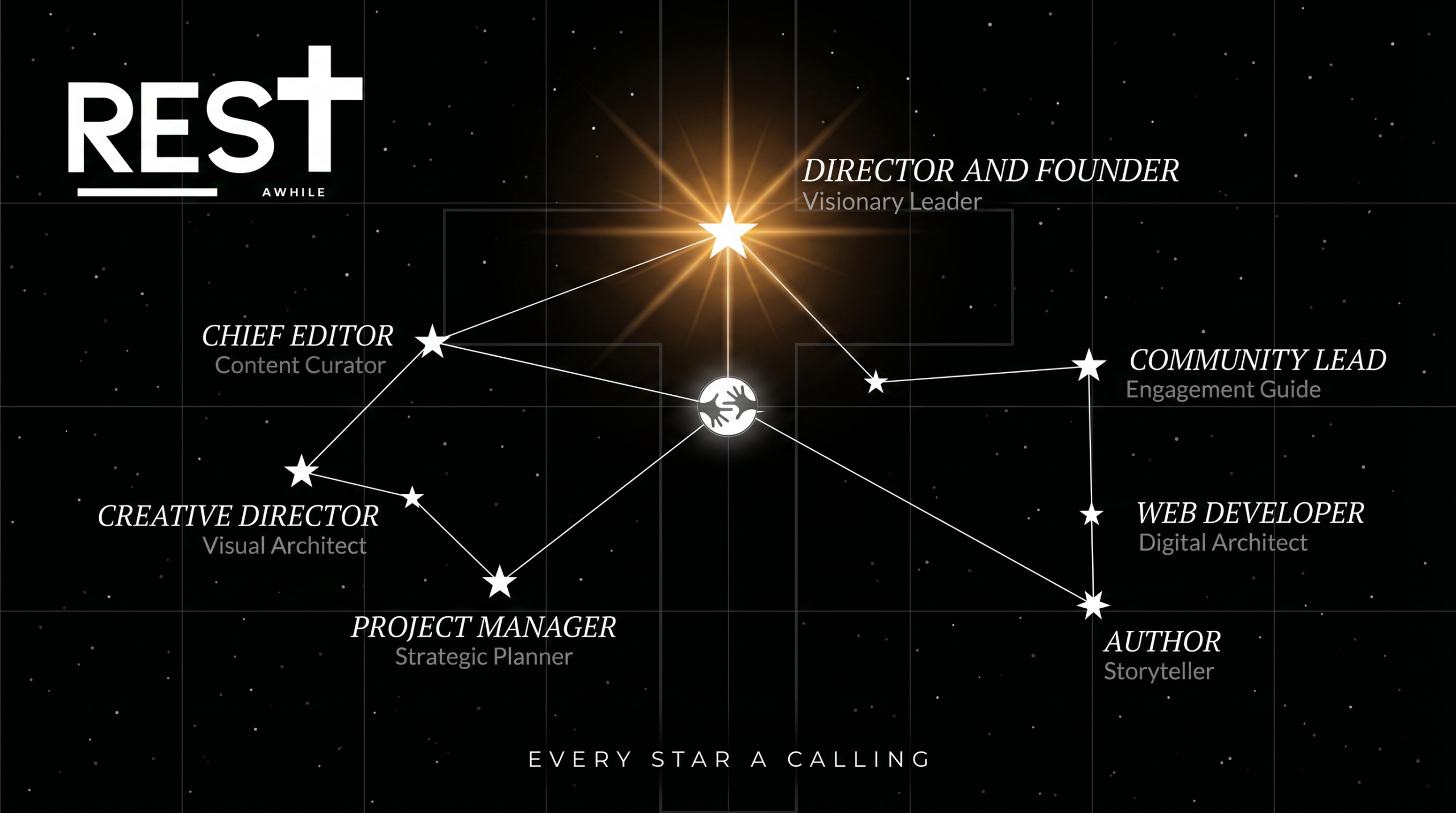
The Director carries the vision → Chief Editor guards the standard → Creative Director makes the ministry beautiful → Project Manager makes the content strategic → Community Lead makes the audience feel at home → Web Developer makes the platform work → Author gives the whole thing its voice and reason for existing.
These roles do not operate solo. The best version of RestAwhile™ is one where every person on this team knows what every other person does — and actively supports them in doing it well.
Read each other’s work. Ask questions. Offer help. Celebrate each other’s wins. And when something is hard, say so.
This is a family. One united by the conviction that rest is not a luxury for the few but a gift meant for everyone.
And every single thing you do here, in whatever role you hold, is an act of offering that gift.